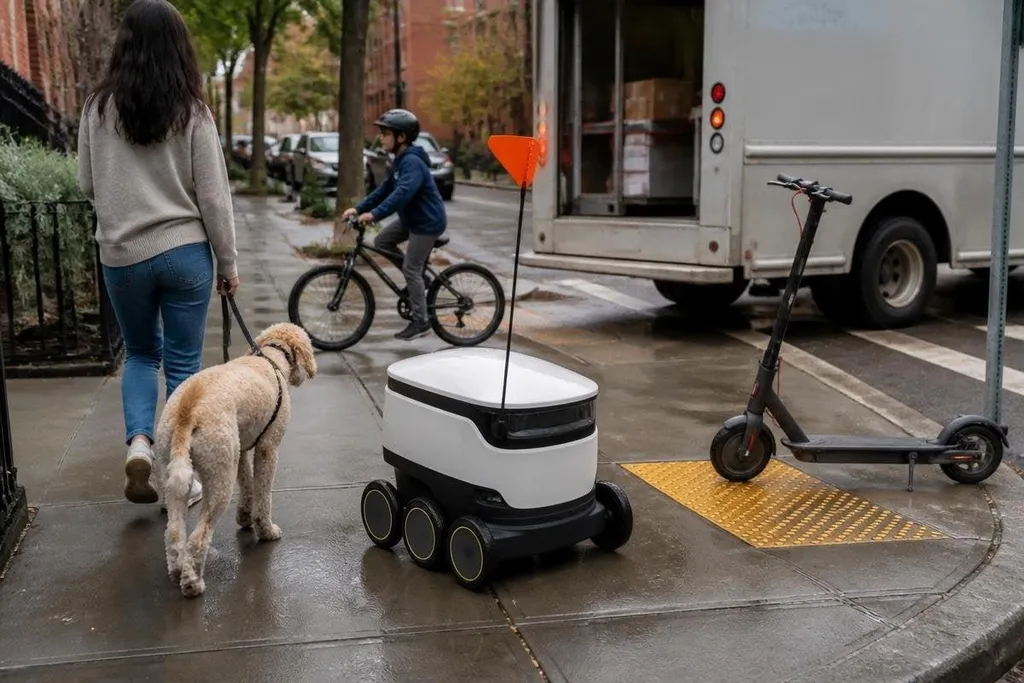
A sidewalk robot has to share space with people, dogs, bicycles, driveways, curb ramps, and bad weather before it reaches one front door. That makes its future depend less on a clever demo and more on safe movement through ordinary streets.
- Cameras, LiDAR, and ultrasonic sensors let the robot detect people and obstacles.
- Remote operators may still need to guide the robot through blocked paths.
- Local rules and access to sidewalks could decide where deliveries are allowed.
The robot must read the sidewalk
A route looks simple on a map. At ground level, the robot needs to spot a child stepping sideways, a parked scooter across the path, or a delivery van blocking a curb ramp.
Cameras can identify shapes, LiDAR measures distance, and ultrasonic sensors can detect nearby objects at short range. Those sensors only give the robot raw information, so software must turn that information into a safe move, such as slowing down, stopping, or choosing a different part of the sidewalk.
A route that works in an empty test area may fail when people move in several directions at once. The machine also needs a clear way to ask for help.
Teleoperation means a person can view the robot's cameras and guide it when the software cannot make a safe choice. That person may need to handle a blocked crossing, a narrow path, or a rider who stops directly in front of the robot.
The hard part is sharing space
On a public path, the robot cannot assume that people will move aside. It must keep enough distance, avoid sudden turns, and stop without creating a new obstacle. Its speed matters too: moving slowly can improve safety, but a very slow robot may block the path or take too long to finish a delivery.
The design also affects access. A tall box, wide wheelbase, or poor turning circle can make a curb ramp hard to use. A robot that reaches the destination but cannot cross a driveway or enter a building has not finished the job.
One blocked curb ramp can turn a short delivery into a staff task. Robot24.com can record the route, access problem, handoff, and trial date, so the business case includes the work needed when the robot cannot finish alone.
The business case needs more than a low driving cost
A sidewalk robot may reduce the need for a person to drive a short delivery route. That does not remove the cost of charging, cleaning, repairs, remote supervision, customer support, or lost units. A fleet also needs a plan for damaged sensors, dead batteries, and packages that customers fail to collect.
The delivery handoff creates another test. The robot needs to reach the right address, keep the package secure, and let the customer open the correct compartment. If the customer cannot reach the robot from a wheelchair, or the robot stops on a narrow path, the system has shifted work back to people.
I'd back sidewalk robots first in places with repeatable routes, wide paths, and staff nearby. Dense public areas with tight sidewalks are a harder fit until the machines can handle blocked routes without frequent human help.
What remains unproven
The open question is not whether a robot can move along a sidewalk. Machines already use cameras, range sensors, motors, and software to do that in controlled settings. The harder test is the number of interventions needed across a full day of changing traffic and weather.
Public acceptance matters just as much. People may tolerate a robot carrying food across a private site but react differently when it takes space on a busy public path. Clear markings, a reachable stop button, and a way to report a problem can matter as much as the drive system.
Rules will also shape the market. Cities may set limits for speed, size, parking, remote monitoring, or access to crossings. A robot maker that plans routes around those rules from the start will have fewer changes to make when a pilot moves into normal service.
A practical test before buying or approving one
Use this checklist when judging a sidewalk robot project:
- Route fit: map curb ramps, crossings, narrow sections, and building entrances.
- Human help: record how often a remote operator must guide the robot.
- Safety response: test stops near moving people, pets, bicycles, and blocked paths.
- Package handoff: check reach, access, security, and what happens after a failed delivery.
- Daily care: count charging, cleaning, sensor checks, repairs, and staff time.
- Local rules: confirm where the robot may travel, wait, and cross a road.
A useful pilot should publish those results instead of showing only successful trips. The next measure that matters is not the number of robots on a sidewalk, but how many deliveries each one completes without blocking people or calling for help.